Real money earning games in India should not be treated as a guaranteed income source. Before trusting an app’s payout promise, identify what you must pay, what you can receive and whether the provider is allowed to offer that particular activity. A familiar game format or a withdrawal screenshot does not answer those questions.
Reviewed: 16 October 2026. This article corrects earlier claims that skill games and voucher contests are automatically legal or risk-free. It also removes monthly earning estimates that were not backed by verified payout evidence.
Quick overview
| Claim you see | What to establish |
|---|---|
| “Skill game” | The actual payment and prize structure, not just the label. |
| “Real cash” | Whether the balance is withdrawable and under what conditions. |
| “Free entry” | Whether later purchases, deposits or stakes are required. |
| “Voucher reward” | Redemption value, expiry and restrictions. |
| “Instant withdrawal” | Eligibility, minimum amount, processing terms and provider identity. |
What changed in India’s online gaming framework?
The Promotion and Regulation of Online Gaming Act, 2025 defines online money games by payment of fees, deposits or other stakes with an expectation of monetary enrichment. Skill, chance or a combination can be involved. The Act prohibits offering these games, related advertising and payment facilitation, while treating qualifying e-sports separately.
The official 2026 Rules announcement gives 1 May 2026 as the commencement date. Its classification framework considers stakes, expected winnings, revenue structure and how rewards or assets are monetised. An official determination is specific to the game and provider.
Do not rely on an old article saying that all skill-based cash games are permitted. Nor does changing a prize label from “cash” to “points” automatically settle classification. This page explains the framework; it does not provide a legal clearance for any operator.
Cash games, entertainment and work are different
Playing a game for enjoyment, entering a qualifying competition and being paid to perform work should not be combined into a single “earning app” category. A game tester’s job, for example, involves an employer or client and an agreed task. An in-app promise of winnings is a different arrangement.
Likewise, a leaderboard does not prove that an event qualifies as an e-sport. Read the event’s rules, organiser details and relevant recognition or registration information. Do not deposit money merely because an advertisement describes an event as competitive gaming.
How to read an app’s balance correctly
Separate the figures shown in the app. Purchased currency, promotional credits, locked bonuses and eligible withdrawals may each have different conditions. Adding them together can make the apparent reward look larger than the amount available to you.
Ask these questions before spending time on an offer:
- What unit is the balance measured in: rupees, coins, vouchers or store credit?
- What written rule allows conversion or withdrawal?
- Does redemption require additional spending, referrals or a minimum balance?
- Is there an expiry date or a limit on how much can be redeemed?
- Who is responsible for resolving a missing payout?
If the terms do not answer these questions, the payout remains unverified. A “successful” message in an app is weaker evidence than a completed receipt in the relevant bank or wallet account.
Why no daily earning figure is promised here
There is no substantiated universal amount for how much a reader can earn from these activities. A useful estimate would need the actual time spent, eligibility, task availability, failed redemptions and net amount received.
For your own records, distinguish time spent from money received. If a reward is only a discount on a purchase you would not otherwise make, do not count its face value as cash earnings. Never treat an unredeemed balance as money available for essential expenses.
Free rewards are not automatically cash
Google Opinion Rewards illustrates the distinction: its Android guidance describes survey rewards as Google Play credit, with variable survey availability. It is not a cash game or a promise of regular income.
For more on non-deposit offers, see our guide to no-investment rewards, credits and redemption checks. A free installation can still involve time, mobile data and personal information.
Before providing documents or paying a fee
Check the provider’s identity and the purpose of any identity-verification request. Do not upload sensitive documents to an unknown chat contact or a copied website. A request for identity documents is neither automatic proof of fraud nor proof that an operator is legitimate.
Pressure to pay an extra “release fee,” changing withdrawal conditions and demands for your OTP or UPI PIN are reasons to stop. Do not send further money to recover an app balance solely on a support agent’s promise.
If you want to stop using an app
Save your transaction records, the relevant terms and any unresolved support messages. Check whether there is a subscription or separate account to close. On Android, open Settings, find Apps, choose the app and use Uninstall; the exact labels vary by phone.
Uninstalling does not by itself resolve a payment dispute, cancel every subscription or delete data held by a provider. Follow the provider’s published billing and account procedures and retain records until the issue is settled.
Frequently asked questions
Are skill-based real money games automatically legal?
No. Skill alone does not exclude an activity from the current online-money-game framework. Its payment and reward structure matters.
Does a Play Store listing prove government approval?
A listing is not an official determination that a particular money-gaming model is permitted. Check the applicable rules and provider-specific evidence.
Is a non-cash prize always risk-free?
No. Redemption restrictions, data collection, time costs and the underlying game structure still need review.
Which app guarantees daily cash?
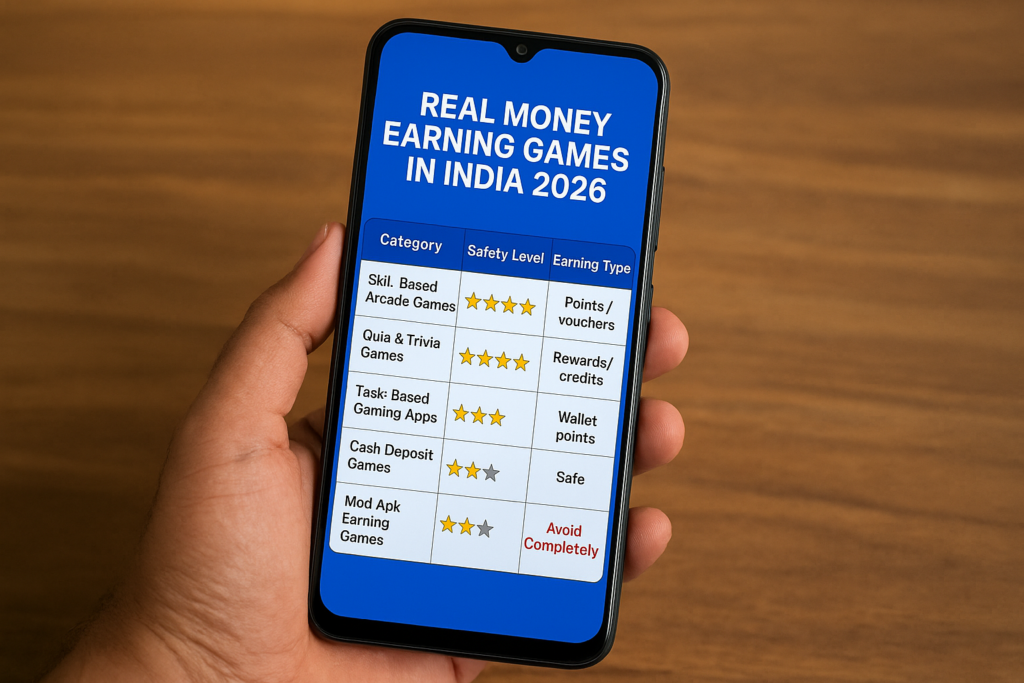
This guide has not verified any such guarantee and does not recommend relying on one. Real money earning game claims require evidence, not a list of unsupported star ratings.