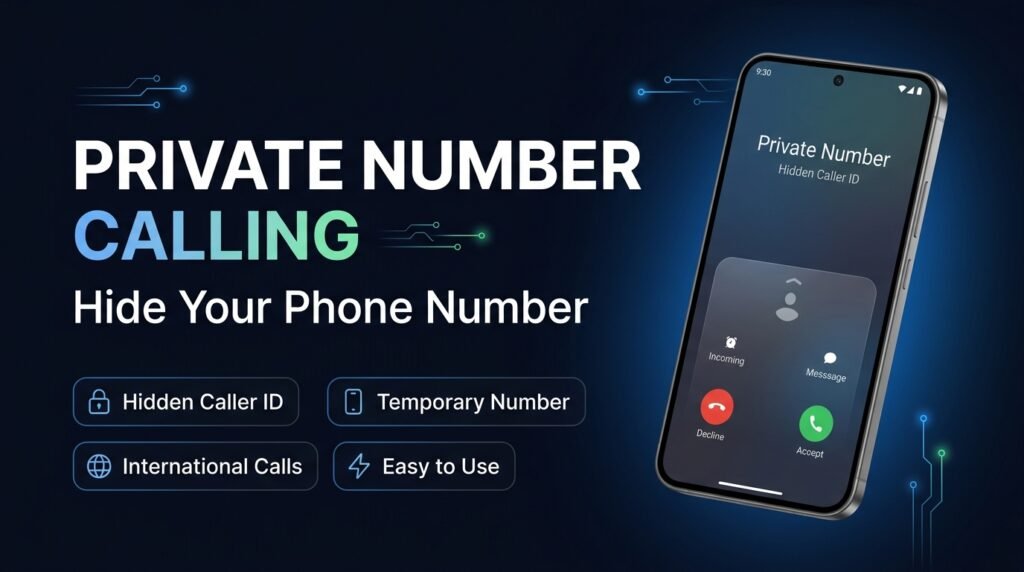
Calling without showing your personal number, calling without a SIM in the device, and registering without a phone number are three different things. A virtual-number app may solve one of these needs without solving the others. Decide which one matters before choosing a service.
There is no single “free calling app without a number” feature shared by every app. Registration, caller ID, destination coverage, pricing and account recovery depend on the provider.
What do you actually need?
| Your goal | What to check |
|---|---|
| Keep your personal number private from a new contact | Username discovery and phone-number visibility controls. |
| Call from a device with no SIM | Internet calling support and how the account is registered or recovered. |
| Call an ordinary mobile or landline number | Telephone-network calling, destination rates and caller ID. |
| Maintain a separate business number | Number eligibility, renewal, retention and portability terms. |
Username privacy is different from numberless registration
Signal provides a useful example. Its phone-number privacy guide describes usernames that let people initiate contact without exchanging phone numbers. In Settings, Privacy, Phone Number, users can manage who sees or finds them by their number.
Those controls do not make a number unknown to someone who already has it. Signal also explains that conversations can merge when an existing contact connects by username. Review the exact behaviour before assuming that a new username creates a separate identity.
Separately, Signal now documents an optional phone-numberless registration feature for Android beta. It involves a one-time purchase and account/recovery keys. This is a beta-specific feature, not a promise that every stable version or platform offers free numberless registration. Losing the required keys can prevent account recovery.
What a virtual phone number changes
A virtual number gives you a separate telephone number through a service. It may help separate work and personal contact, but it does not mean that the provider has no account information about you. Check what is displayed to recipients and what happens when someone calls back.
Do not assume that every number can receive verification messages or be used with every bank or messaging service. Check the receiving service’s requirements before attaching an important account to a temporary number.
Country availability matters
A service advertised overseas may not offer numbers to users in India. For example, the Google Voice Play listing states that personal Google Accounts are supported in the US and Google Workspace accounts in selected markets. It should not be presented as a universally available free Indian virtual-number service.
Check your eligibility through the provider’s official information. A download being visible does not establish that number assignment or every calling feature is available for your account.
Calling over Wi-Fi does not always mean carrier Wi-Fi Calling
An internet app can carry a call over Wi-Fi or mobile data. Carrier Wi-Fi Calling is a separate feature tied to a supported mobile service and device. Do not assume that enabling one provides the benefits, phone-number support or emergency routing of the other.
A phone without an inserted SIM may still use an already configured internet-calling account, but registration and recovery may require access to a phone number or another credential. Check both before relying on an old phone as your only way to communicate.
What “free” can leave out
Separate the app download from the calling cost. Ask whether calls are limited to other users of the app, whether ordinary numbers cost credits, and whether a virtual number has a renewal fee. Also check credit expiry, destination rates, advertisements and data charges.
For a specific credit-based example, our Fast Call guide explains why a free installation does not guarantee unlimited calls. Compare the full cost with your existing phone plan before paying.
Keep control of the number and account
Read inactivity and renewal rules. Google warns in its Voice policies that an unused number may be reclaimed under its stated conditions. Other providers have their own rules.
If you stop using a number, update recovery details on important accounts first. Save recovery credentials privately, use the provider’s account protections and avoid sharing OTPs with someone who claims to be activating your service.
Before your first call
- Verify the publisher and use its official app-store listing.
- Read the privacy policy and permission explanations.
- Confirm the destination rate and caller-ID behaviour.
- Make a short, agreed test call before depending on it for important communication.
- Keep a separate confirmed method for emergency calls.
Common questions
Does hiding my number make me anonymous?
No. Recipient visibility is only one privacy setting. Account information, service records and what you reveal during a conversation are separate considerations.
Can I call any ordinary number through a username?
A username usually identifies an account within a service. Telephone-network calling must be explicitly supported; it is not implied by username support.
Should I buy a number just for OTPs?
First check whether the intended service accepts that number type and whether you can retain long-term control. Losing a temporary number can create account-recovery problems.
More Articles You May Like